


This article is a sponsored feature from Mining.com.au partner Empire Metals. It is not financial advice. Talk to a registered financial expert before making investment decisions.
Empire Metals (AIM:EEE) is in the process of reshaping its identity, shifting from an overseas-focused explorer to an Australian-based developer, drawn by the stability, clarity, and maturity of Australia’s mining landscape.
The move delivered more than new tenure. It led the company to Pitfield, a vast sedimentary basin north of Perth, where the team originally started looking for copper and gold projects. What they drilled instead was something far more unusual — a titanium-rich ore body unlike anything that had been seen before in Australia.
Managing Director Shaun Bunn joined the company when it came to Australia five years ago, bringing local expertise across project development, exploration, and, importantly, mine development. Bunn says his experience was exactly what Empire Metals needed to move through the next phase of its journey.
Part of that journey is to solidify the company within the Australian market, and Empire Metals is gearing up for an IPO on the Australian Securities Exchange (ASX).
Bunn says the company has had a great experience with the London market, with excellent liquidity and support from the local investment community. However, he highlights that the differences between the two investment communities were a key motivator in pursuing an Australian IPO to support Empire’s next phase of development.
“With our flagship project and our technical team now here in Australia, it’s an excellent opportunity for the company to gain the attention of more institutional investors and funds who take a longer-term view of our value proposition,” Bunn says.
Empire will retain its London listing as well as its OTC quote, allowing the company to continue trading in the US and giving it a much broader international reach than the average Australian junior.
Following the acquisition of Pitfield, Empire flew airborne magnetics and gravity surveys across the area and found a massive geophysical anomaly within the tenement — one that had never been drilled before.
“We were really excited because it was a sedimentary basin. We thought we’d found the world’s largest copper project,” Bunn says.
“We drilled it three years ago and found out it was full of titanium, so now we’re a titanium-focused company and concentrating on how we can develop this amazing ore body.”
Pitfield is now emerging as one of the world’s largest and ‘highest-grade’ titanium deposits, positioned in a jurisdiction with rail, gas, power, and renewable energy already in place.
With China dominating supply and Western nations seeking secure alternatives, Empire believes its integrated processing pathway, pure titanium dioxide mineralogy, and strategic location place it at the centre of a rapidly shifting global supply chain.

Pitfield: A hidden titanium giant
“Pitfield is a unique ore body. It’s a freak of nature,” Bunn says.
“It’s one of the largest titanium deposits on the planet and it’s not mineral sand, but a sedimentary basin.
“The mineral systems we’re tracking go down kilometres deep, and we’ve only drilled it to 400m to date.”
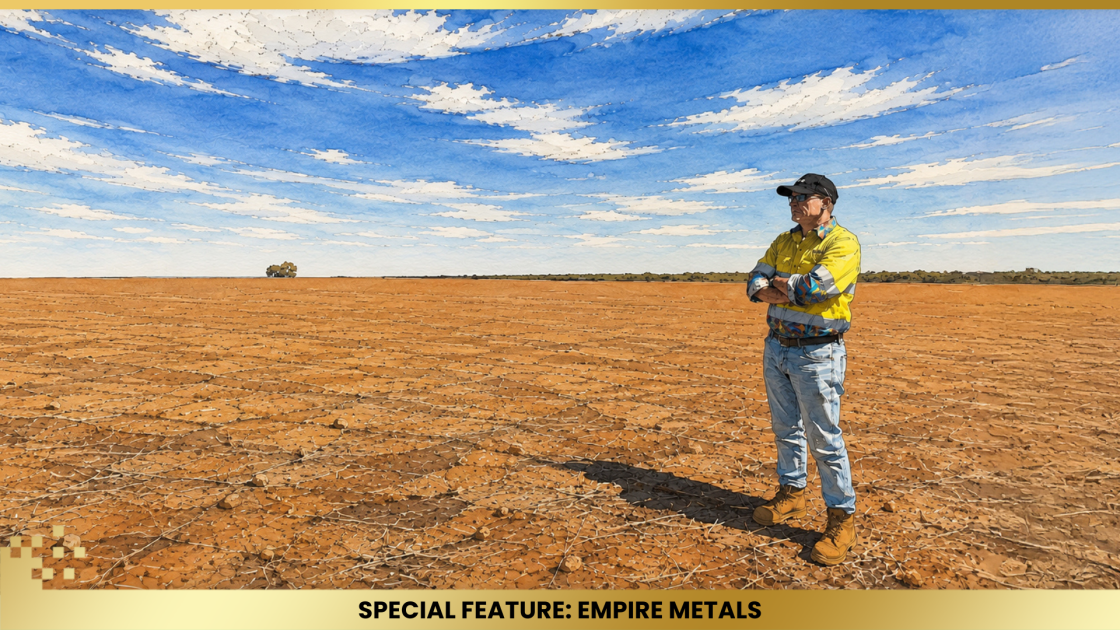
Pitfield is located a three-hour drive north of Perth in a wheatbelt farming region, with rail, a natural gas pipeline, high-voltage electricity, wind, and solar all accessible to the company. The natural gas availability and other structural advantages add up to significant cost benefits for Empire. With a rail connection to Geraldton Port, the company is able to ship things out at lower cost than by road.
With infrastructure already in place, Empire also benefits from Pitfield’s location in a mature mining jurisdiction, with all the principles and processes for environmental, social, and other mining approvals being clearly mapped out.
“We know what we have to do and there’s no ambiguity,” Bunn says.
The company took on an environmental manager two years ago, prior to working out a processing plan, with the goal of getting the environmental input complete early in the development phase. Empire has now added two more environmentalists to the team and is working on all necessary approvals.
“As a consequence of this being farmland, there’s not a lot of native vegetation that needs to be cleared, so we’re not restricted by that,” Bunn says.
“We are, however, thinking about how to work with the farmers so that we can return the farms back to their original use in the long-term.”

Integrated processing unlocks major cost advantages
Empire Metals recently announced that it has moved through its metallurgical testing and established a fully integrated processing flowsheet, taking the ore from the mine through to a final pigment-type product in a single facility. Bunn notes this approach is quite unusual for the titanium industry and is enabled by the mineral characteristics of the Pitfield ore body.
The cost advantages that this integrated facility offers provide additional upside.
“We don’t make a concentrate at a remote site and then have to transport it thousands of kilometres, and we don’t have the overhead of operating in multiple areas. We’re able to condense everything into an integrated process,” Bunn says.
Bunn notes that the ore body doesn’t have any ilmenite, but is a titanium dioxide material called anatase, with additional rutile and titanium hematite. He explains that ilmenite is an iron-titanium oxide, containing roughly 50% titanium dioxide (TiO₂) and 50% iron oxides. Around 90% of the global titanium supply comes from ilmenite. Pitfield’s material, on the other hand, is nearly 100% TiO₂.
“We have this additional cost advantage over the ilmenite industry because when we process that mineral, it consumes less acid and requires less energy input to get the titanium out of it,” Bunn explains.
“We’re very fortunate in a number of ways, but it’s fundamentally the ore body that creates this opportunity for us to be a low-cost producer.”

MRE confirms one of the world’s largest titanium resources
Pitfield currently stands as one of the largest titanium resources globally, with the 2025 mineral resource estimate (MRE) outlining 2.2 billion tonnes @ 5.1% TiO₂ for 113 million tonnes (Mt) of contained TiO₂.
The MRE also outlines an indicated resource of 697Mt at 5.3% TiO₂ for 37.2Mt of contained TiO₂.
Up until the middle of 2025, Empire completed just over 32,000m of drilling, which led to the release of the maiden MRE in October 2025.
Bunn notes that the company commenced another drill program at the start of 2026, drilling 34,844m over 712 drill holes, taking the total cumulative metres drilled to 67,846m across 1,104 holes, with the goal to substantially upgrade the MRE and increase the company’s confidence in the resource.
“We have indicated resources at one of the targets and we wanted to look to bring that into measured, as well as increase the size of the resource that we have,” Bunn says.
“Not that we need more, because 2.2 billion tonnes could keep us going for hundreds of years, but we wanted optionality around where we would look to mine.”

Titanium industry at a turning point
Bunn notes that the past decade has brought a massive change in the titanium industry, with China emerging as the dominant supplier of low-cost titanium, often as a byproduct of the titanium-rich magnetite being mined for iron ore.
This low-cost output has allowed Chinese producers to scale rapidly, putting pressure on Western producers who have mostly gone into administration or have cut back on production, unable to compete at cost.
While titanium is widely known for its use in pigments and paints, its strategic importance lies in aerospace applications for the world’s major economies and defence powers. With strength comparable to steel at roughly half the weight, titanium has become indispensable for aircraft, air defence systems, fighter jets, drones, and other advanced platforms.
This defence-driven demand has elevated titanium to a matter of geopolitical priority across the West. With the biggest producers being China, followed by Russia, global markets have seen significant supply chain disruption at a time when demand continues to grow steadily.
“The timing of this project is perfect,” Bunn says.
“Over the next few years, across Europe, North America, and elsewhere, governments and manufacturers are going to be actively looking to secure a Western supply chain for titanium.”
Fast-tracking a Western titanium supply chain
Empire Metals’ next phase is centred on accelerating development at Pitfield while positioning the company as a future cornerstone of the Western titanium supply chain.
The company sees a clear pathway to becoming a fully integrated titanium producer, with the ability to supply both pigment-grade product and feedstock into the metal industry. While Empire does not expect to build a titanium sponge facility itself, it is advancing research with Murdoch University in Perth in addition to working with federal agencies on critical minerals to ensure its product can become a key feedstock into the metal industry.
“We see a really important strategic position where we could partner with a metal supplier, provide feedstock into the metal industry, and secure a lot of support from the federal government,” Bunn says.
“But our main aim would be to find strategic partners, probably more from the downstream and end-user side — companies that need the metal to make aircraft or pigments for paints.”
Bunn expects future strategic partners to come from the downstream and end-user industries, which are increasingly looking to secure long-term Western supply chains. Rather than direct operational support, Empire says that investment through direct funding and offtake agreements is the most likely route.
Operationally, Empire will continue drilling at Pitfield, though Bunn stresses that the company does not need to find more ore. The focus is on refining the ‘high-grade’, near-surface targets to support mine planning, which is scheduled to commence in the next few months.
Pilot-scale testing for the integrated flowsheet will commence by the end of Q3 or early Q4 2026. Empire will leverage Perth’s ‘world-class’ international metallurgical laboratories, which can operate pilot rigs without Empire needing to build a bespoke facility upfront. This will allow the company to run continuous piloting, produce market-ready samples for potential offtake partners, and further derisk the flowsheet.
Engineering and economic studies will also begin shortly, with Empire aiming to provide the market with greater visibility on cost structure once modelling is complete.
As Empire advances Pitfield toward development, Bunn says the biggest challenge has been getting the message out to the market about the ore body. The scale, grade, purity, and simplicity of the project have created what Bunn describes as “a sense of disbelief”.
“When you find a unicorn, people think that it can’t actually exist, but this thing does,” Bunn says.
With no deleterious elements, no waste stripping, and a simple, ‘high-purity’ ore body, Bunn believes Pitfield’s development trajectory is unusually fast — and unusually straightforward.
“I love this ore body. It’s unusual, it’s a freak, but it’s a really happy one,” Bunn says.
Bunn notes that Empire is not necessarily a market disruptor, but is operating in a disrupted market. With geopolitical tensions on the rise and countries weaponising minerals, the company is developing what it believes to be the world’s largest titanium deposit at a time of accelerating demand.
As Empire Metals moves into mine planning, pilot-scale testing, and strategic partnership discussions, Bunn says the market is finally waking up to what Pitfield represents: a Western-aligned titanium supply opportunity arriving at exactly the moment global demand, geopolitics, and supply chain pressures are converging.
Write to Amy Rotman at Mining.com.au
Images: Mining.com.au, Empire Metals


